EcoPel Gathers to Plant Seedlings
From a simple question asked in 2021 — “What happened to the hummingbirds?” — a long-running, community-led restoration effort began taking shape across public green spaces and transportation corridors in the Town of Pelham.
The question came from the late Benny Bulfamante of Mario Bulfamante & Sons while discussing the loss of everyday wildlife and pollinators from neighborhood landscapes. That conversation helped spark a partnership among the Environmental Coalition of the Pelhams (EcoPel), local municipalities, the New York State Department of Transportation (NYSDOT), community volunteers, and Mario Bulfamante & Sons that continues today.
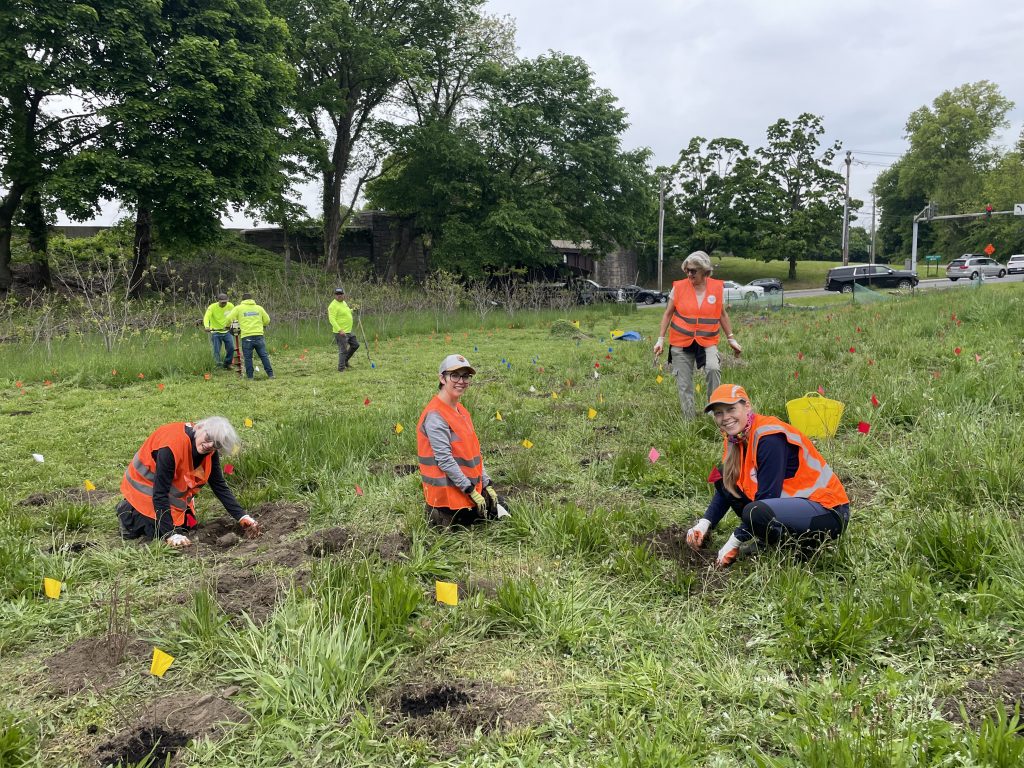
On Saturday, May 9, that effort continued as volunteers gathered once again at the Hutchinson River Parkway Adopt-a-Highway Exit 4B corridor at Boston Post Road and Split Rock Road in Pelham Manor to plant more than 400 native shrub seedlings grown by the New York State Department of Environmental Conservation’s Saratoga Tree Nursery through EcoPel’s Plant Pelham Native initiative.
Alongside Bulfamante’s crew, volunteers planted Virginia rose, black chokeberry, chokecherry, winged sumac, bayberry, and sand cherry bare-root seedlings in connected drifts designed to support the gradual succession of the existing meadow into a shrubland edge habitat more reflective of the historical coastal ecology associated with the Long Island Sound watershed.
The planting marked a milestone: more than 2,000 native shrubs have now been planted by volunteers through EcoPel-led restoration efforts.
In just four years, the work has steadily expanded. What began at Veterans Park with Girl Scouts Troop #1667 planting 25 seedlings evolved into meadow restoration projects, invasive vine management, and the formation of the Pelham Vine Squad to manage newly restored habitats. The effort later grew into Girl Scouts Troop #2617’s Silver Award project, Plant Pelham Native, which continues to scale and organize volunteers around ecological restoration projects throughout the community.
Over the past five years, more than 341 volunteers have contributed approximately 569 volunteer hours through habitat restoration projects, invasive plant management, native plantings, and floatable trash cleanups — bringing residents of all ages together around a shared concern for habitat loss and a shared love of nature.
Why does this work matter? Across our region, tree canopy is declining while lawns increasingly dominate parks, roadsides, and residential landscapes. At the same time, ornamental and invasive plants are often favored for convenience or appearance over ecological value. Together, these trends contribute to biodiversity loss, weakened food webs, poorer soil structure, and diminished ecosystem services such as stormwater absorption, water filtration, and urban cooling.
What began with concern over disappearing hummingbirds has grown into a community-driven effort to rethink public green spaces and roadsides as living infrastructure for cleaner water, healthier habitats, and a stronger watershed.
Most importantly, the work continues the spirit of Benny Bulfamante — who believed that people who care can make a difference, and that working together to improve a place also strengthens friendships, civic pride, and everyday community connections.
The Environmental Coalition of the Pelhams (EcoPel) is a volunteer-led 501(c)(3) organization dedicated to advancing environmental stewardship, education, and community-based action. Through initiatives such as Plant Pelham Native, the Pelham Vine Squad, and the Seed Library, EcoPel works to restore habitat, improve water quality, and engage residents in caring for the natural systems that support a healthy, resilient community.